Skill Categories - The Blended Lesson Structure
The philosophy behind the Blended Quest - and how its components map to skill Categories in Musician Quest.
Written By Dave Hemann
Last updated About 1 month ago
Blending mastery with musicianship
The Blended Quest combines structured skill development with creativity, connection, and personalization - so students aren't just checking off skills; they're becoming musicians.
The word "blended" is deliberate: you're blending mastery with musicianship. The skills provide the roadmap, while creativity, collaboration, and choice make the journey personally meaningful.
The four components
Each Level in a Blended Quest draws on four kinds of skills:
Core Skills - the essential musical and technical skills the student is working toward. This is the mastery backbone of the Level.
Creative Project - an opportunity to use those skills creatively through improvising, composing, arranging, or creating something of their own.
Collaborate - a musical experience with someone else, such as a duet, jam, ensemble, or performance.
“Show Off” Skill - a tune, piece, or idea the teacher chooses because it resonates with that student - something they are proud to share or "show off" to family or a friend.
Then the Level ends with a Celebration - video accomplishments, a level-up, a reward, a performance, or other recognition of progress.
The simplest version:
Learn it. Create with it. Share it. Show it off. Celebrate it.
How this maps to Categories in Musician Quest
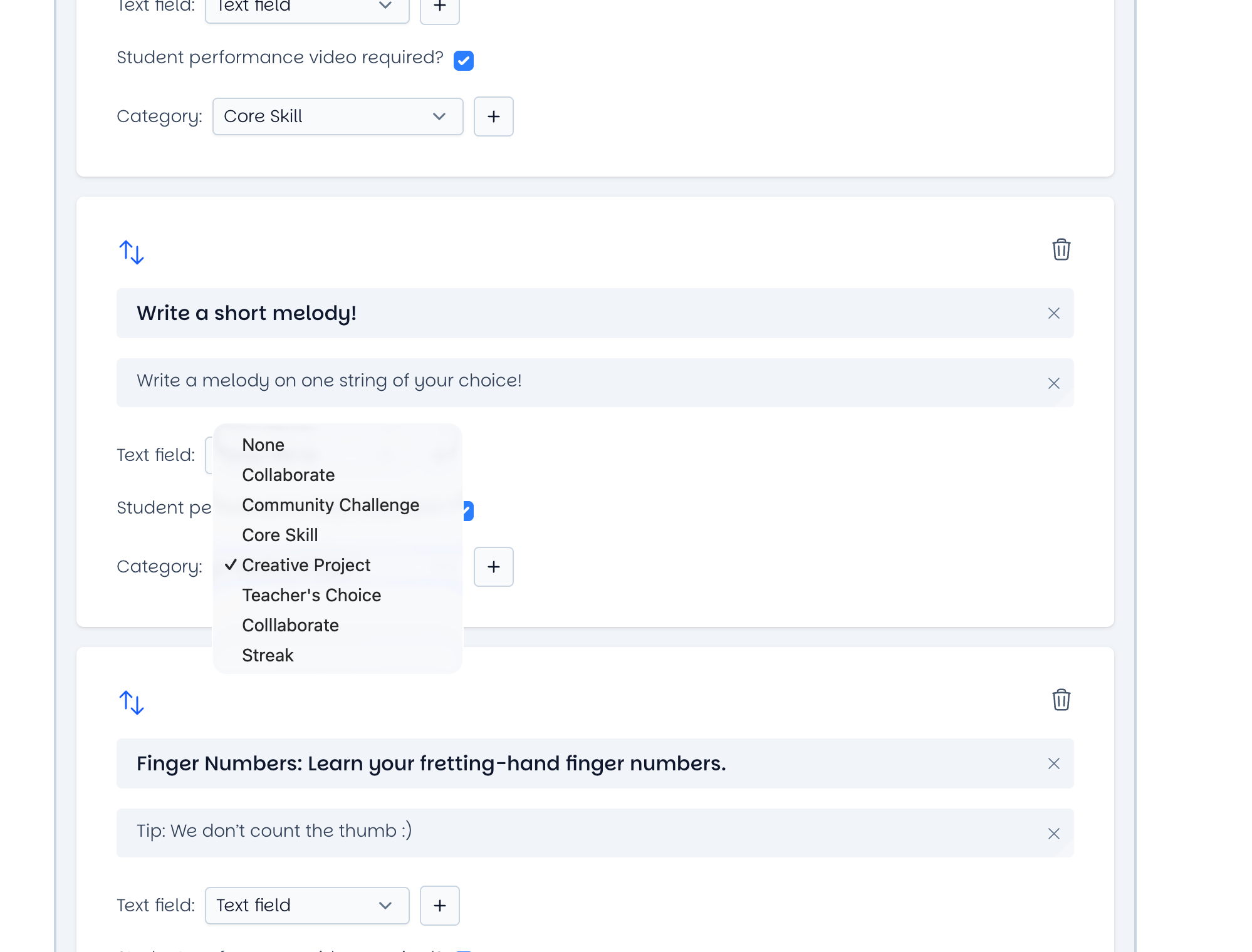
Every skill in Musician Quest has a Category - a label that appears on the skill's card for teachers, students, and families. When you build a Quest, MQ offers these starter categories:
Core Skill
Creative Project
Collaborate
Community Challenge
Teacher's Choice
Core Skill, Creative Project, and Collaborate map directly to the Blended components above. The Show Off Skill is usually built with the Teacher's Choice category, paired with the Song name text field so the piece travels with the skill - or add your own "Show Off" category if you want that label on the skill card. Community Challenge is a close companion to Collaborate - use it for skills where the music reaches beyond the lesson room, like performing for family or friends, joining a jam, or playing in an ensemble.
Two things to know:
Categories are yours to shape. The list above is a starting vocabulary, not a limit - you can add your own category values as you build, and they'll persist on your Quest's skills. (Some studios add categories like Streak for practice challenges.)
Celebration isn't a category. It's what happens when a Level completes: the reward moment at the front desk, the level-up, and the growing video timeline. You don't need to build it as a skill - the structure delivers it.
The research behind the structure
The Blended Quest is informed by research on motivation in music education. Evans, McPherson and Davidson (2013) studied people roughly ten years into their musical lives and examined what was happening motivationally when they were highly engaged versus when they stopped playing. They found that decisions to cease music learning were associated with diminished feelings in three areas: competence, autonomy, and relatedness.
Those three needs - drawn from Self-Determination Theory - map onto the Blended Quest:
That last row - recognition of growth through the video timeline - is Musician Quest's own application of the research, not a finding of the study itself. The defensible claim is this: research found that students' decisions to stop making music were associated with diminished feelings of competence, autonomy, and relatedness, and the Blended Quest is designed to support those needs by combining skill mastery, creative choice, and making music with others.
Does variety actually support retention?
No study has tested the Blended Quest itself, so the honest claim is a two-link chain - and both links are well supported by research.
Link one: varied content is how a lesson satisfies the three needs. A lesson that only drills technique can build competence while starving autonomy and relatedness. Core Skills, Creative Projects, Collaborate, and Autonomy (the Show off skill) each pull a different motivational lever - that is what "blended" means in practice. Renwick and McPherson (2002) captured the choice lever vividly: in a case study within a larger longitudinal project, a beginning clarinetist practiced a piece she chose herself roughly twelve times longer than her assigned repertoire, and with more advanced practice strategies.
Link two: satisfying those needs strongly predicts sticking with music. Beyond the Evans, McPherson and Davidson finding above, Freer and Evans (2018) found that psychological needs satisfaction, together with the value students placed on music, explained 65% of the variance in high school students' intentions to continue studying music. Evans and Liu (2019) found the same pattern in a high school orchestra program, where needs satisfaction and frustration explained substantial variance in both practice time and intentions to continue.
Put together, the defensible sentence for studio owners is: lessons that blend skill mastery, creative choice, and playing with others support the psychological needs that research links most strongly to whether students keep playing.
Further reading:
Evans, P., McPherson, G. E., & Davidson, J. W. (2013). The role of psychological needs in ceasing music and music learning activities. Psychology of Music, 41(5), 600-619. Read the study
Evans, P. (2015). Self-determination theory: An approach to motivation in music education. Read the paper
Freer, E., & Evans, P. (2018). Psychological needs satisfaction and value in students' intentions to study music in high school. Psychology of Music, 46(6), 881-895. Read the study
Evans, P., & Liu, M. Y. (2019). Psychological needs and motivational outcomes in a high school orchestra program. Journal of Research in Music Education, 67(1), 83-105. Read the study
Renwick, J. M., & McPherson, G. E. (2002). Interest and choice: Student-selected repertoire and its effect on practicing behaviour. British Journal of Music Education, 19(2), 173-188. Read the study
Using this when you design a Level
When you review a draft Level, check the blend:
a solid core of skills that build competence
at least one creative prompt that gives the student ownership
at least one skill that involves making music with someone else,
and a Show Off Skill the student is proud to share.
Put together, the defensible sentence for studio owners is: lessons that blend skill mastery, creative choice, and playing with others support the psychological needs that research links most strongly to whether students keep playing.
Was this helpful?
Still need help? Ask the team